On-Demand Everything: How Nigeria's Gig Economy Is Coming for Your Haircut
Nigeria already gets food, rides, and groceries to the door. Here's why grooming is next — and what a $5.17B gig economy means for how the country gets its haircut.
On-Demand Everything: How Nigeria's Gig Economy Is Coming for Your Haircut
Ten years ago, "I'll get it delivered" meant a favour from someone passing your way. Today, a Lagos afternoon can look like this: lunch arrives by bike, a ride shows up in four minutes, groceries land at the gate, and an errand runner picks up a parcel across town — all from a phone, all without anyone leaving the couch.
Somewhere in that shift, Nigeria quietly became an on-demand nation. And once a country learns to expect things at its door, it starts asking a simple question of every old habit: why doesn't this come to me too?
The haircut is next.
Nigeria didn't announce it — but it's already an on-demand economy
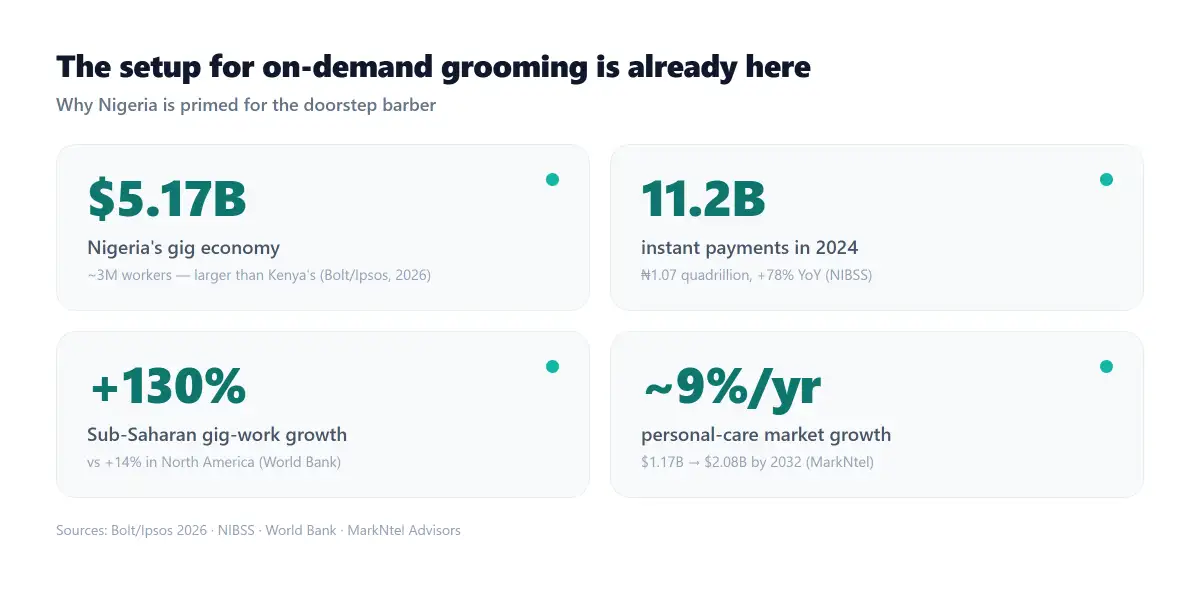
The numbers are no longer small. A 2026 Bolt/Ipsos study valued Nigeria's gig economy at about $5.17 billion — roughly 2.8% of GDP — supporting around 3 million people. On the same methodology, that's larger than Kenya's (~$1.2 billion), though Kenya still leads in online, remote freelancing. Food delivery and ride-hailing have already made "summon a stranger to your door" feel completely normal.
And the wave is accelerating fastest right here: across Sub-Saharan Africa, online gig-work postings grew 130% in the years to 2023 — versus 14% in North America, according to the World Bank.
What's really being built here isn't just delivery. It's a habit — the expectation that convenience is a tap away, and a comfort with letting vetted strangers into your day. Every category that adopts this model makes the next one feel obvious.
The rails are finally in place
On-demand doesn't work on ambition alone; it needs infrastructure. Nigeria now has the pieces:
- Phones and connectivity — around 150 million mobile connections (~64% of the population) and 107 million internet users, with GSMA projecting smartphone penetration will reach 91% by 2030.
- Payments that clear instantly — Nigerians moved ₦1.07 quadrillion across 11.2 billion instant-payment transactions in 2024 alone, up roughly 78% in value year on year (NIBSS). Paying a stranger through an app is already routine.
- Location services — the global market for location-based services is growing at about 9% a year, powering the "who's near me, right now" question every doorstep service depends on.
- A young, mobile workforce — around 60% of Nigerian gig workers already treat it as their main income, not a side hustle.
Put those together and you don't just get food logistics. You get a platform layer that any service — including grooming — can ride on.
Grooming is a big market stuck in an old model
The appetite is clearly there. Nigeria's beauty-and-personal-care market is projected to grow from $1.17 billion in 2025 to $2.08 billion by 2032 — about 9.3% a year (MarkNtel Advisors), and men's grooming across the Middle East & Africa is compounding at roughly 6.45% a year, with Nigeria named a key market (Mordor Intelligence).
What hasn't caught up is the experience. For most men, "getting a cut" still means the Saturday ritual: travel across traffic, wait your turn behind three other heads, and hope your barber isn't off that day. It's the one part of a grooming-conscious life that still runs on 2005 logistics.
Every category that can come to your door eventually does. Grooming is simply next in line.
Why the barbershop queue is the next thing to disappear
Convenience doesn't win markets all at once. It wins them one habit at a time — and it always follows the same logic: your time is worth more than the trip.
We've already watched it happen in-market. Nigeria's online food-delivery sector — the closest analogue to on-demand grooming — is on track to more than double, from about $1.1 billion in 2025 to roughly $2.7 billion by 2034 (IMARC Group). The doorstep-service model isn't theoretical here; it's already scaling. Grooming is simply the next to-your-door category in line — and outside a handful of Western cities, almost no one is building it yet, which is exactly what makes Nigeria an open frontier.
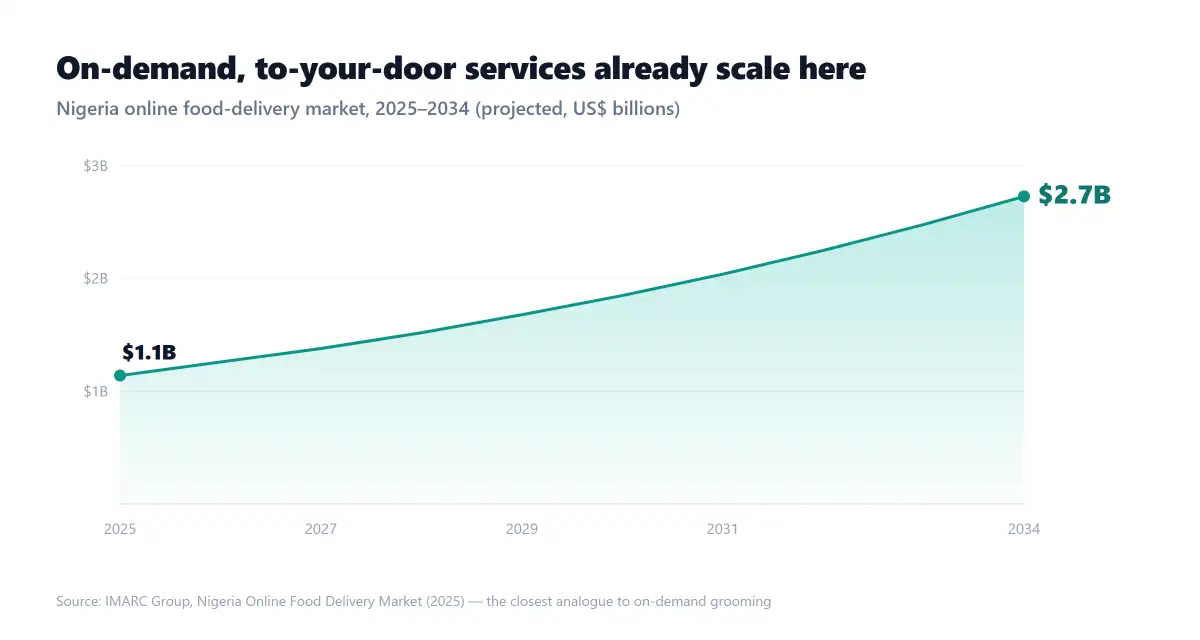
The doorstep cut isn't a novelty. It's the same shift that already happened to food, rides, and errands — arriving, at last, at the barber's chair.
The catch: on-demand grooming runs on trust
There's a reason grooming didn't get "Uber-ed" the moment food did. A haircut is intimate. You're inviting someone into your home, handing them sharp tools, and paying for skill you can't inspect in advance. Convenience alone won't close that gap — trust will.
That's the hard part, and it's also the moat. On-demand grooming only works when a platform can answer, before anyone knocks on your door:
- Who is this barber? Verified identity and an approved profile — not a random number.
- Are they any good? Real reviews and ratings from real clients.
- Is this actually them? A genuine, recognisable profile photo, not a logo or a stock image.
- Is my money safe? In-app payment with a record, not on-the-spot haggling.
Get that right, and a stranger at the door becomes a professional you booked with confidence.
Freshcutr is building the on-demand barber layer for Nigeria
This is the shift Freshcutr is built for: bringing vetted, verified barbers to your door, backed by real profiles, ratings, and secure payments — so a great cut is something you book in minutes, on your schedule, right at home.
For customers, it's the end of the Saturday queue. For barbers, it's a way to build a real, mobile business and earn on their own terms. And for Nigeria's grooming market, it's the same on-demand upgrade the rest of daily life already got.
The country learned to expect everything at its door. The haircut is simply catching up.
Sources
- Nigeria gig economy ($5.17B, ~3M workers): Bolt/Ipsos "Nigeria Gig Economy Report" (2026), via TechEconomy Nigeria — https://techeconomy.ng/nigeria-gig-economy-bolt-report-5-17bn-3-million-workers/
- Kenya gig economy comparison (~$1.2B, 1.5M): Bolt Kenya/Ipsos report, via Moses Kemibaro (2026) — https://moseskemibaro.com/2026/03/21/kenyas-us-1-2b-1-5m-people-strong-gig-economy-is-no-longer-a-side-hustle-unpacking-the-bolt-kenya-ipsos-gig-economy-report/
- Sub-Saharan online gig-work growth (+130%): World Bank, "Working Without Borders: The Promise and Peril of Online Gig Work" (2023) — https://www.worldbank.org/en/news/press-release/2023/09/07/demand-for-online-gig-work-rapidly-rising-in-developing-countries
- Nigeria online food-delivery market ($1.1B → $2.7B by 2034): IMARC Group (2025) — https://www.imarcgroup.com/nigeria-online-food-delivery-market
- Instant payments (₦1.07 quadrillion / 11.2B transactions, 2024): NIBSS, via Nairametrics (2025) — https://nairametrics.com/2025/01/29/e-payment-transactions-in-nigeria-hit-all-time-high-of-n1-07-quadrillion-in-2024/
- Connectivity (150M connections, 64%; 107M internet users): DataReportal, "Digital 2025: Nigeria" (Kepios/GSMA Intelligence) — https://datareportal.com/reports/digital-2025-nigeria
- Smartphone penetration 91% by 2030: GSMA, via Investors King (2025) — https://investorsking.com/2025/03/26/gsma-forecasts-91-smartphone-penetration-in-nigeria-by-2030/
- Location-based services market (~9% CAGR, global): MarketsandMarkets (2025) — https://www.marketsandmarkets.com/Market-Reports/location-based-service-market-96994431.html
- Nigeria beauty & personal care ($1.17B → $2.08B by 2032, 9.3% CAGR): MarkNtel Advisors (2025) — https://www.marknteladvisors.com/research-library/nigeria-beauty-personal-care-market-study.html
- Middle East & Africa men's grooming (~6.45% CAGR): Mordor Intelligence (2025) — https://www.mordorintelligence.com/industry-reports/mea-mens-grooming-products-industry

Comments
Loading comments…